
Discovering a new histone variant
Unlike most eukaryotes, trypanosomatids contain variants of all core histones. In T. cruzi, however, an H4 variant had not previously been characterized. The researchers combined genomic location, sequence comparison and phylogenetic analysis to identify H4.V as a distinct single-copy histone H4 variant.
The study then examined where H4.V is located in the genome and how its abundance changes as the parasite progresses through its life cycle.
H4.V is most abundant in the infective stage
The researchers investigated whether H4.V was produced at the same level throughout the parasite's life cycle.
Protein extracts from different developmental stages were analysed by Western blot. H4.V was present in epimastigotes, increased progressively during metacyclogenesis and reached its highest abundance in metacyclic trypomastigotes. In contrast, H4.V was only weakly detected in the mammalian-stage amastigote and tissue-culture-derived trypomastigote samples.
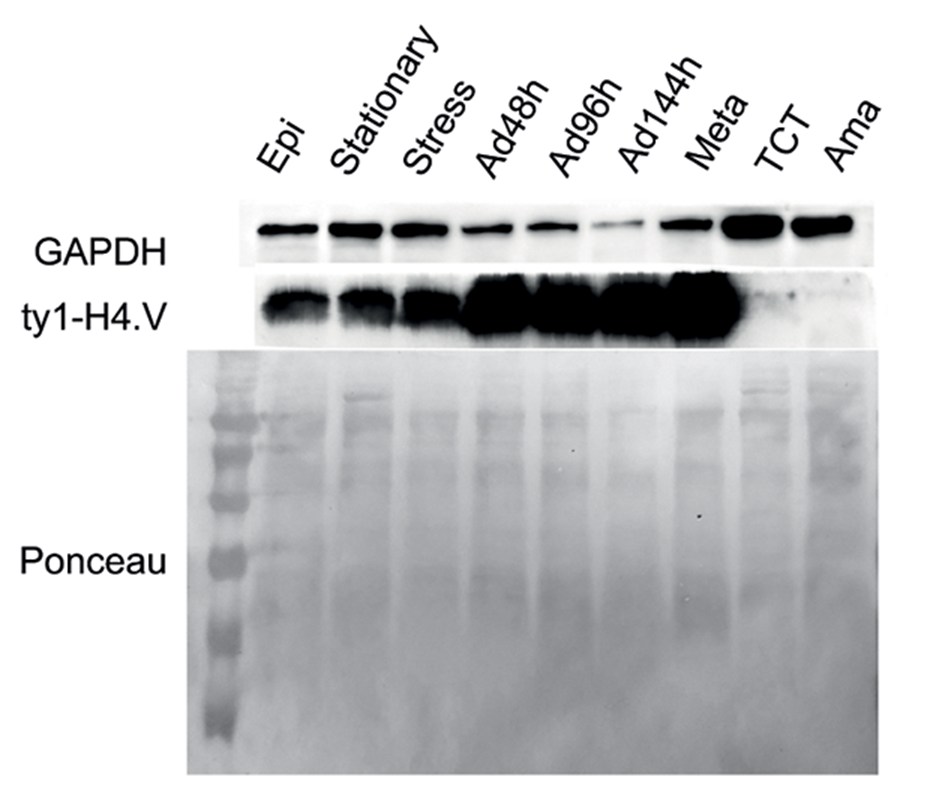
H4.V increases during differentiation and is strongest in the metacyclic sample, while signal is much lower in TCT and amastigote samples. Excerpted from Fig. 5B of Roson et al. (2026), PLOS Pathogens, CC BY.
H4.V marks regions associated with transcription termination
To understand the role of H4.V, the researchers mapped its location across the parasite's genome.
Rather than being randomly distributed, H4.V was consistently found at many regions where gene transcription ends. It was also enriched near chromosome ends, where several genes involved in parasite virulence are located. These findings suggest that H4.V acts as a chromatin marker that helps define the boundaries between groups of genes and contributes to the organization of the parasite's genome.
A histone strongly associated with chromatin
Finally, the researchers examined how tightly H4.V remains attached to chromatin.
Compared with another histone variant, H2B.V, H4.V remained associated with chromatin under conditions that progressively released DNA-binding proteins. This stronger association was particularly evident in the parasite stages that develop inside the insect vector.
Together, these results suggest that H4.V contributes to the structural reorganization of chromatin as the parasite progresses through its life cycle.
Conclusion
The study establishes H4.V as a distinct T. cruzi histone variant with characteristic genomic localization and strongly life-stage-dependent abundance. Its enrichment at transcription termination regions and strong chromatin retention in insect-stage forms support a specialized role in parasite chromatin organization.
The authors note that the precise biological role of H4.V - including any direct contribution to virulence-gene regulation or host adaptation - remains to be established in future functional studies.
Results at a glance
Glossary
Chromatin: The complex of DNA and proteins that packages genetic material inside the cell. Its organization helps control which genes can be used by the cell.
Genome: The complete set of genetic information (DNA) contained in an organism.
Histone: A protein that DNA wraps around, allowing it to be compactly organized inside the cell.
Histone variant: An alternative form of a histone protein that helps organize specific regions of the genome and can influence gene activity.
Gene transcription: The process by which the information stored in DNA is copied into RNA, the first step in gene expression.

Sales Director