A protective mechanism that unexpectedly promotes survival
The aim of this study was to determine whether E::R induces OIS, contributing to the long-term survival of pre-leukemic cells. Using inducible cell models and transgenic mice expressing E::R, researchers found that pre-leukemic cells displayed the classical hallmarks of cellular senescence.
To understand why these dormant cells escaped elimination, the team analyzed proteins involved in the cellular stress response using Western blot. Protein expression was measured using the Alliance Q9 Advanced imaging system (Uvitec Cambridge), enabling sensitive chemiluminescent detection and reliable protein quantification.
The analysis showed that E::R activated p53 and drove cells into a senescence-like growth arrest. To test whether p53 could still trigger apoptosis after DNA damage, the researchers exposed the cells to a DNA-damaging treatment. While control cells activated the expected apoptotic response, E::R- positive cells did not, indicating that they had become resistant to apoptosis and could survive despite accumulating genetic damage.
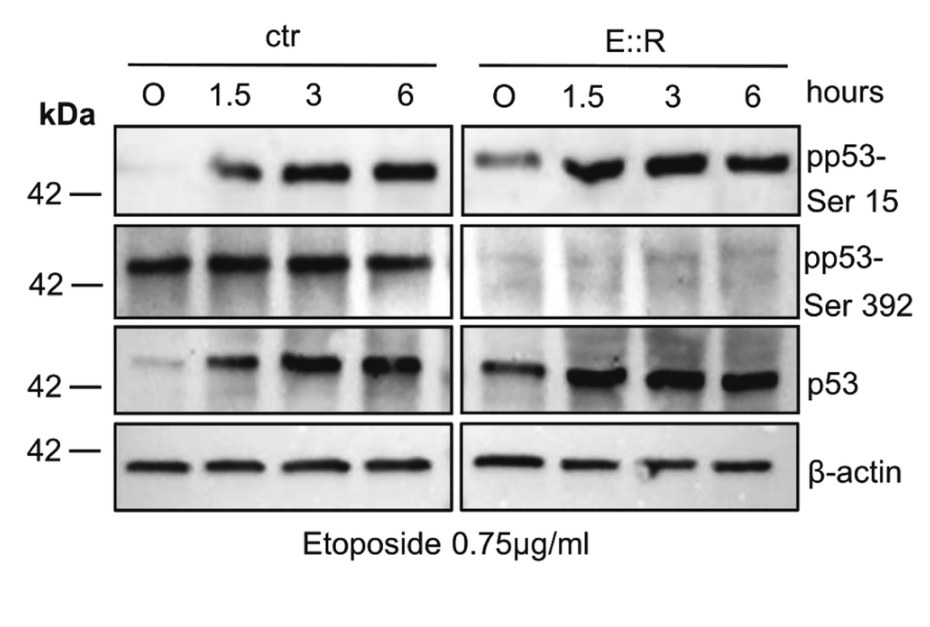
Western blot analysis comparing p53 phosphorylation after DNA damage in control and E::R-positive cells. Pp53 Ser15 (an early marker of p53 activation) is expressed in both control and E::R-positive cells, showing that both respond to DNA damage. However, pp53 Ser392 (required for p53-mediated apoptosis) is only expressed in control cells but not in E::R-positive cells, indicating that the p53 stress response is activated, but the apoptotic response is not. Image extracted from Acunzo et al., 2026, Cell Death Discovery.
Targeting senescence exposes a therapeutic vulnerability
The researchers then explored whether this survival mechanism could also become a therapeutic opportunity.
Because E::R-positive cells relied on senescence-associated pathways to persist, they tested several senolytic compounds designed to selectively eliminate senescent cells. All three compounds preferentially eliminated ETV6::RUNX1-positive cells while largely sparing control cells. One was shown to significantly reduce pre-B colony formation from pre-leukemic progenitors isolated from transgenic mice, providing proof of principle that senolytic therapies may help eliminate pre-leukemic cells before leukemia develops.
Conclusion
This study shows that ETV6::RUNX1 reprograms OIS into a survival mechanism, allowing pre-leukemic cells to resist apoptosis and persist over time. By identifying senescence as a therapeutic vulnerability, the findings highlight the potential of senolytic therapies to eradicate pre-leukemic cells, although further studies will be needed to validate this approach in vivo and in humans.
Results at a glance
Glossary
Oncogene-induced senescence (OIS): A cellular program in which activation of an oncogene normally halts cell proliferation, acting as a natural barrier against cancer.
ETV6::RUNX1: A fusion gene generated before birth and commonly associated with childhood B-cell acute lymphoblastic leukemia.
P53: A key protein that helps protect the body by stopping damaged cells from dividing or by triggering apoptosis when DNA damage is too severe.

Sales Director